Translate

Wednesday, September 11, 2013

First Team Retreat

One of the parts of this job that I was most interested in when we applied was being a part of (and leaders of) a team. I love facilitating group activities and also having time to hang out in teams. Some of the best memories of my life are from group bonding. We will have team retreats every few months and after this first one I am convinced it will be something I look forward to throughout our time here.
Because we have staff that live 8 hours away (or more), many traveled into the city the night before we left for the retreat. We enjoy hosting guests and had almost all of the team members over to our apartment for dinner the night before. And several slept in our living room. A pre-retreat hang out.

I'm thankful that our staff have attached to our girls. Ellie talks about all the staff being "her friends." 
The retreats are usually near where one of the team members live and work. This retreat was in Alta Verapaz, about 4-5 hours north of the city. We ate most of our meals on this covered patio attached to our hotel overlooking the city of Coban.

We spent the morning on business and get-to-know-you activities. We have staff who only speak Spanish, and others who speak very limited Spanish (including myself), so we have to translate or speak in both languages throughout our meetings.
Next, the team headed to an agroecology educational center. It's a large farm on top of mayan ruins. It's run by ex-MCC staff who came to Guatemala about 12 years and worked for 6 years with MCC. Now they do this. 

They host educational programs where local Ke'kchi young women come and learn basic skills. They are currently building dorms and bathrooms and can host up to about 40 people at a time. (For much better pictures, go here. For more information about this conservation and agroecology leadership training program, click here).
We took a hike on the gorgeous premises and headed for some caves.
Nothing says team bonding like hiking through the mud and rain.
Big cave.
Why not grab a family photo inside a big, dark cave?
And while we're at it, a team photo too.
Team MCC Guatemala/El Salvador.
To get to and from the caves we had to cross these bridges. 
We were told to walk across them one at a time as they are a bit precarious. 
I decided not to make Hazel walk across by herself. (Just kidding).
Ellie loved seeing animals all over the place. 
Here, she's posing with one of our staff members, Lilian.

On Friday, after a morning of connecting and bidding farewell to the Murch family who will be ending their internship with MCC in less than a month, we visited Bezaleel, a vocational school connected to the local Mennonite and Q'eqchi (indigenous group) churches, where the Murches have been working.
The boys dorms are on the second floor and there are classrooms below.
 One of the many buildings on campus.
 Ellie had a blast playing with these kids for two days straight.
 John, one of our staff who has been helping teach the carpentry classes, helped build these picnic tables (check this out to see the process) that were placed throughout the campus. The genius of these is that there are no chairs and they are EXTREMELY heavy so they don't disappear!
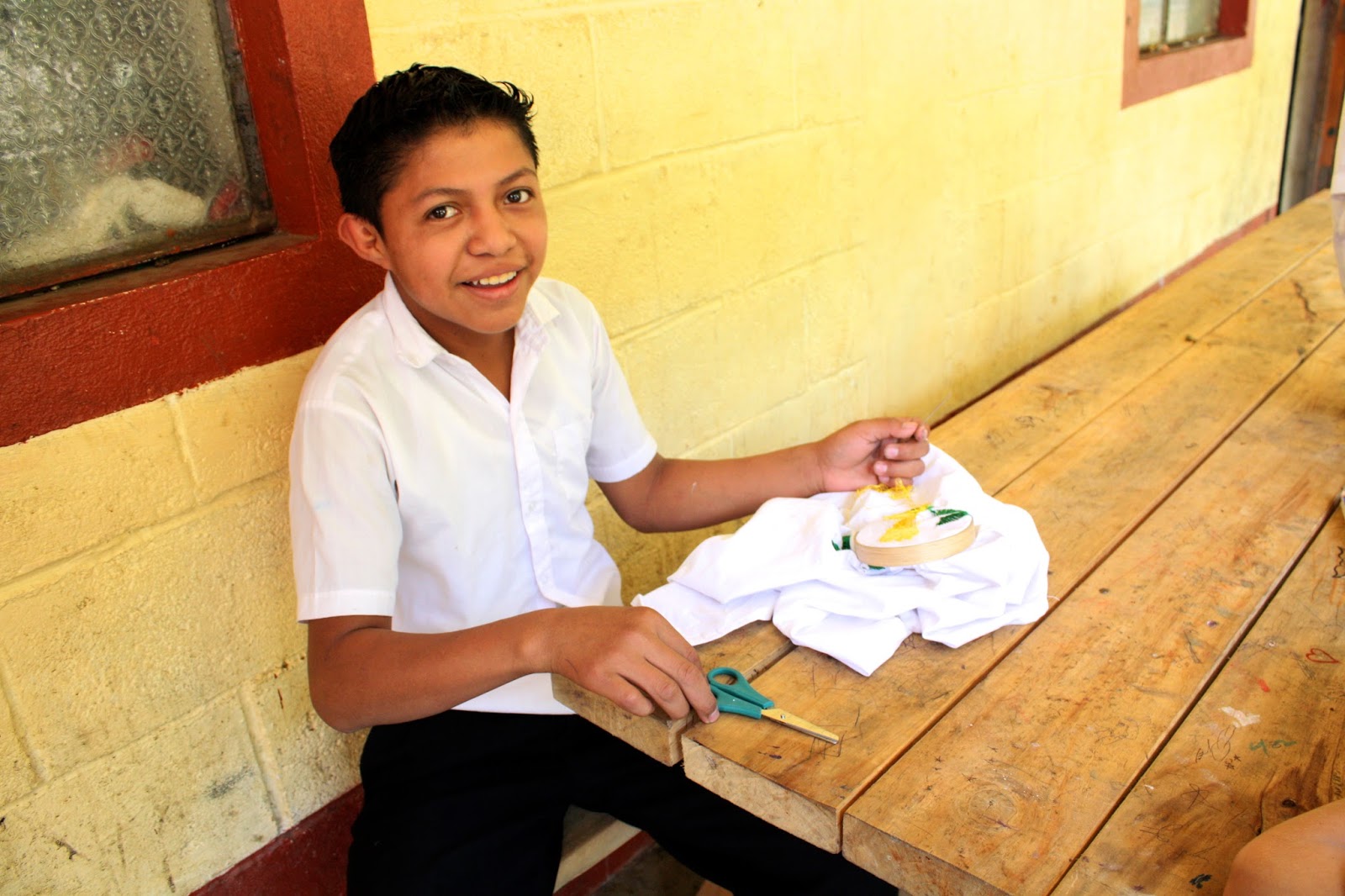
Sewing.
 One of the classrooms. I don't know if it's usually decorated like this or if it's in preparation for the big Independence Day celebrations coming up this weekend.
 The library. Yes, those are all the books. 
 This is Jennifer. She has been teaching baking classes. Here, she's showing us the cake pans that her crafty husband not only made, but in a previous MCC assignment in Nicaragua, taught local women to make to sell (you can read about that amazing story here). (Also, if you haven't gone to her blog yet, you should. I've linked to her blog several times).
Cooking lunch. 
 Simple bread recipe.
 Meet Beraldo. He's from Colombia and just joined our team for a year through the YAMEN! program. He's working in Sibinal and we took him to his assignment just a week ago. He and Hazel are buddies.

After our visit to Bezaleel we stopped by the market for a quick lunch before our drive back to Guatemala City.

We decided to eat a quick lunch from these women. They make tortillas and fill them with cheese or sausage or both. Similar to pupusas but, in my opinion, pupusas are better.

We had a wonderful time at our retreat. It was fun to be with the team for the first time. We played a lot of card games in the evenings and laughed a lot. And ate a lot of chocolate. 

With the way MCC staff cycles through, every staff retreat will have changes. We will be saying goodbye to the Murch family as well as another staff member in the next few months.

If you'd like to read about MCC Guatemala and see pictures from the perspective of one of our newest staff members, meet him here on his blog.
And, to see more fun pictures of our retreat, including a couple cute little Chapman girls, go here.
Feeling very blessed to be a part of this team. 

Monday, September 2, 2013

Sibinal and Its Food

During our time in San Marcos, we stayed in Sibinal, a small town where I don't think they see many gringos. Our girls were rockstars walking around. There are two restaurants in town that had been previously "approved" by the tourism industry for health standards and such, so that's where it was recommended we eat during our stay.

A typical Guatemalan breakfast often consists of eggs, refried black beans, fried plantains, tortillas, and sometimes crema to go with it all. You can find that breakfast everywhere throughout the country. Lunch and dinner are similar, but maybe use chicken or beef in place of the eggs.

Most small restaurants or small eateries don't have menus. Usually they will have a "menu of the day" posted on the wall. That's the extent of what's available and it's usually a short list.

In four days in Sibinal we went to the same restaurant six times, usually for breakfast and dinner.

And this is what we got. Every. Single. Time.
Usually this was served with coffee in the morning (very sweet watered down weak coffee) or in the evenings hot chocolate. I have to admit I got used to this food. I never understood why plantains and refried beans went together, (like in the rellenitos I wrote about here). And I often skip the tortillas. But after several days of this plate, I got to really liking the eggs and beans and plaintains all mixed up and scooped into a tortilla. Maybe I'm becoming a chapine (Guatemalan or Guatemateca).
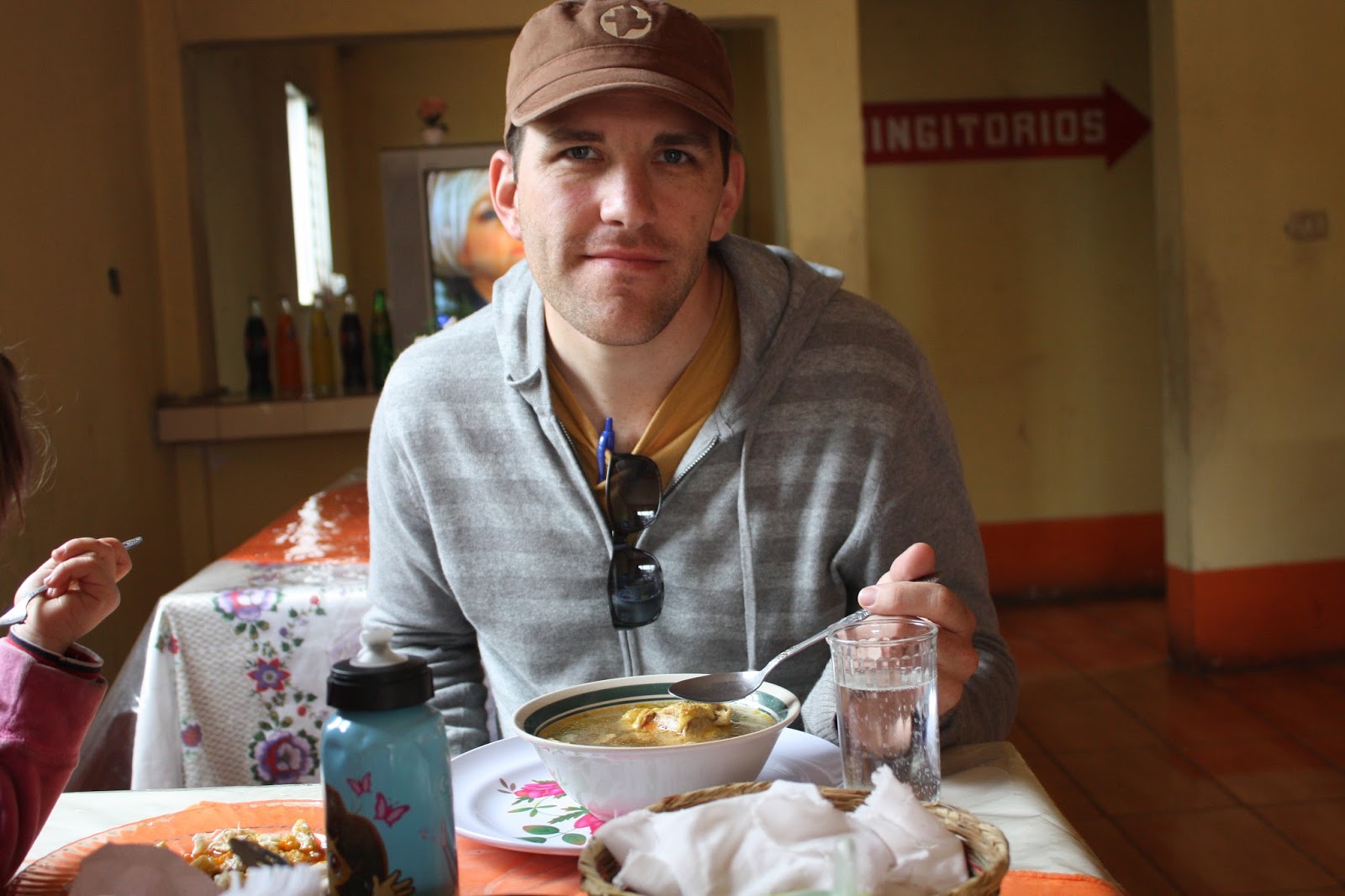
Michael wasn't feeling well on this trip (we think it was beef we ate here in the city), so he usually just ate bread for breakfast, or in this picture, chicken soup.

Oh, side note: I should say regarding our vegetarianism that we've eaten more meat in the last couple months than in the last five years combined. Besides eating a lot of beans and tortillas, being vegetarian here is difficult when eating out. I still don't buy meat or cook with it in my home, but we eat it fairly often when we are out, especially because many people prepare us food and it's usually meat-centered.

The one day we ventured to the other "approved" restaurant I decided to venture out and order the fish. I was excited for something other than eggs! And this is what I got:
I have to admit I was momentarily thrown off by the fish head and fins, but I decided to dig right in. (I had to remember how to tear fish meat off bones). It was amazingly tasty and the only fault was it only had about five bites of meat on the bones.

One of the main purposes of this trip was to take one of our new one-year young adult staff to his host family's home in Sibinal. Here's the back yard of their house:

This family has cats, dogs, pigs, ducks, geese, chickens and roosters walking all over the place. They also have a fish pond in their back yard connected to the river where they raise fish to sell.
Peering at the fish.
The host parents. All the children were gone as well as our staff member, but we posed for a picture anyway.
Throughout our drive to Sibinal, and here in Sibinal, we could hear marching bands playing everywhere, practicing and marching. It's impressive that many of these schools have simple, basic supplies yet have a priority for music and instruments. Here the band is marching in the rain downtown.

The hotel we stayed at had super hot showers with great water pressure, lots of warm blankets, and even a television, all for about $8/person. Not a bad deal!

Sibinal was an interesting town. It was great to see some of the work MCC is doing here in the department of San Marcos. We look forward to our next visit.

Saturday, August 31, 2013

Western Highlands and Hiking a Volcano

Western Guatemalan highlands, as seen from our car.
Last night we returned from a trip to San Marcos, a department (state) of Guatemala in the western highlands bordering Mexico. The purpose of the trip was to accompany a new staff member to the community where he will serve and live with his host family, as well as to visit some projects. We stayed in a small community called Sibinal, nestled in between two active volcanoes, Tajamulco and Tacana.
A common site along the road.
MCC partners with agricultural cooperatives in two communities in this very rural corner of Guatemala. The community we visited is called La Linea, which means "The Line". (Not to be confused with the other La Linea, in El Salvador. See this post.) It is called La Linea because this community finds itself on the border of Guatemala and Mexico.

To get to this community we drove on a very rocky, steep road for more than an hour around the volcano from Sibinal, often having to use 4-wheel drive. It was a bumpy ride. We arrived and these students welcomed us. The community has one road that leads to the school, and then to get to the homes there is a trail straight up the side of Tacana to the community members' homes. This trail is one of two approaches to summit the volcano.
The welcoming committee.
A rousing game of futbol.
(The blue building is the local school).
Watching the students play soccer. 
Fast buddies. These girls helped Ellie pick flowers.
This little girl was washing her cup in the outdoor kitchen sink.
In this community, MCC helps support a number of families to create greenhouses and home gardens. The greenhouses mostly have roses and chrysanthemums that are sold at local markets in Guatemala and just across the border in Mexico, and the home gardens are to help provide a way of sustainable living.

A greenhouse full of flowers.
A special flower with healing properties that is dried to make tea.
More flowers in the greenhouse ready to be cut and sold.
(And a daughter of one family with a greenhouse.)
A major motivation behind these projects is to help families afford to live without needing to migrate to Mexico or the US to work for several months of the year. Instead, these families raise enough food to eat and make enough money selling their flowers to not need to find other work. We met many people who once had to migrate for months at a time who now can stay and provide a livelihood for their families at home.
First sign of strawberries.
Almost every house had several plants growing like this one.
After visiting each house we hiked up more to visit more homes and greenhouses. 
Three levels of greenhouses, each owned and operated by a different family.
We hiked up this volcano to about 8500 feet for over 30 minutes. The volcano's peak reaches over 13,000 feet.
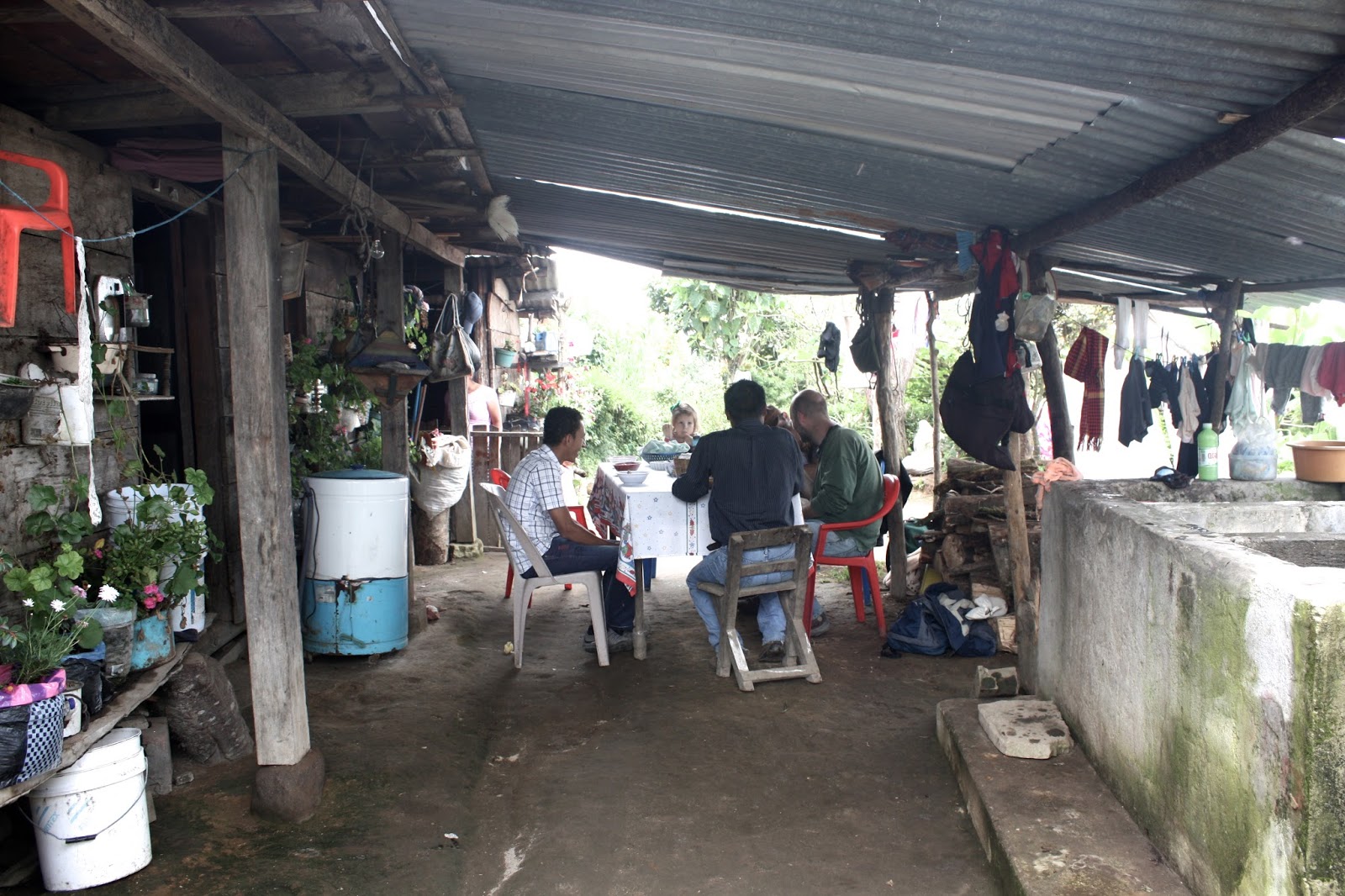
 About half way up the side of the volcano we stopped for lunch.
The kitchen where chicken soup was cooking on the stove.
The girls seem to make friends wherever we go.
Lunch.
("The dining room")
The border between Guatemala and Mexico, divided by occasional cement markers.
After a knee-jarring trip back down the mountain, we got back in the truck and drove about one minute down the road, where it abruptly ended and led to the abyss of a pine forrest. We had reached the porous border with Mexico.

We headed back to Sibinal to take a hot shower and eat some comida tipica, reflecting on the harsh reality of living on the side of an active volcano. We are excited to work with these communities in the coming years. More pictures to come.